That old road's a friend of mine | 11 Feb 2026
kirkkittell.com/newsletter
Intro
Walk-up song: Townes Van Zandt, "Snowin' on Raton", At My Window (1987)
Our mother thinks the road is long and lonely
Little brother thinks the road is straight and fine
Little darling thinks the road is soft and lovely
And I'm thankful that old road's a friend of mine
Words
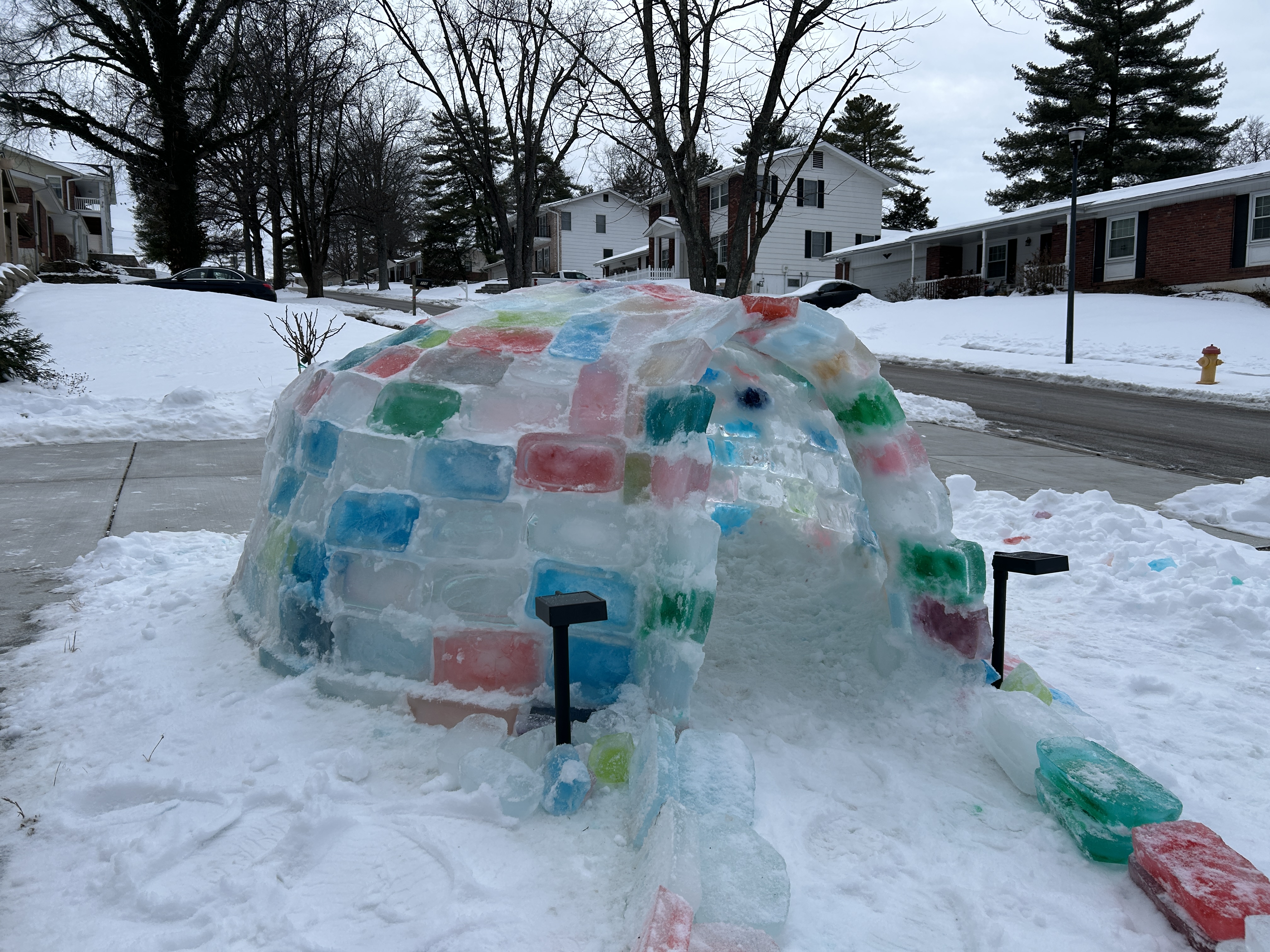
Last week, during the snow and deep, deep freeze here in the Midwest, my wife wanted to go out and build an igloo. I said, "Go ahead", and let her go out and do it.
The end.
Yes, I went out and helped. My tent and sleeping bag aren't rated for sub-freezing weather, so I wouldn't survive long having to sleep in the backyard. Again.
It was fun. I'll admit it. It was better than what I would naturally do in that case—a book, a chair, a few hours disappearing from the cold, cold world.
She saw these people on TikTok or Xiaohongshu building ice igloos in their yard by making ice bricks—with food coloring, a nice touch—in aluminum bread pans. That's it. Make ice bricks, stack them in the right shape, and hey presto, you've got a place to shelter from the storm.
Naturally, once you click into one video, The Algorithm will find you more of those videos, and then it looks like you're the only ones not making an ice igloo in your yard. Fear Of Missing Out, etc. So we got to it: a trip to the store in my Mini Cooper (obviously the right tool for the job when it comes to driving through the snow, bounces right off the telephone poles and back onto the road), picked up some bread pans, and started making ice in eight or twelve hour shifts on the front porch.
I cast a jaundiced eye at the things that social media put on my screen because I know the entire point is to lock me there in front of the screen, a hook right through my cheek. I spend a lot of time there, nearly all of it shame-inducingly vapid. But it's not all bad, right? If the thing that hooks you also gets you up and out and away from the screen, out of the house in terrible conditions to create fun, then that feels like Something Positive—provided you can avoid the next trap, comparing yourself to the best of the best in the world, or at least the most polished of the most polished of the short video publishers in the world. Fear of Coming Up Short, etc.
But it wasn't like that. It was just fun. Over the next few days we spent hours creating ice bricks, then preparing a snow platform, then laying out a course of bricks, then gluing the next course of bricks down with ice and water, then doing it again, then again, then again, until the thing was complete. Eight hour days of Work work during the work week; eight hour days of Fun work during the weekend.
It was almost like we stumbled into a time warp of some kind. Maybe it's just that we live in a suburban area with lots of older people around, but there wasn't anyone else out we could see playing in the snow—no kids or other erstwhile adults. Like maniacs, we were out having old school fun, playing in the snow. There were two types of people who stopped while driving down the streetto talk to us: (1) old people (defined as it always will be: people older than us); (2) younger people (same definition, but younger) with their kids in the back seat. Group 1 treated us like kids having fun in the snow. Maybe they also noticed the lack, and then also the recognition of old school fun. Group 2 treated us like… I have a harder time classifying this one… like people who were recovering a lost technique or technology, like we unearthed something they had only heard about, and asked us questions about how to do it.
After we finished, it was a solid ice structure, but it warmed up well past freezing the next day, and the igloo crashed in on itself within twenty-four hours. Didn't matter. The proverbial Good Time Was Had By All.
Seven links, plus-or-minus two
Kevin Draper. "Hard Times in the Delta as Farmers Consider Letting Crops Rot". The New York Times (2026-01-25).
To the World Wildlife Fund, the solution to these structural barriers to profitability is obvious, if difficult to carry out: Grow food that Americans eat.
Most of what is farmed in Mississippi and the rest of the country isn’t food that goes on Americans’ tables. It is soybeans grown for animal feed, corn grown for ethanol, rice grown to export to Central America and so on. The fruits and vegetables that Mississippians eat are probably grown in California or in other countries.
Douglas Preston. "The Skeletons at the Lake". The New Yorker (2020-12-14).
An unsolved mystery of centuries-old bones high in the Himalayas.
In our conversations, Reich emphasized that the findings of geneticists were almost always unexpected and tended to explode stereotypes. “Again and again, I’ve found my own biases and expectations to be wrong,” he said. “It should make us realize that the stories we tell ourselves about our past are often very different from the reality, and we should have humility about that.”
Steven Levitt. "Ken Jennings: “Don’t Neglect the Thing That Makes You Weird”". People I (Mostly) Admire (2020-10-02).
The most interesting thing, to me, is hearing Jennings talk about having a spatial memory—filing away memories according to the place that they happened. That's more or less how my brain works. I didn't really think I was the only one, but I hadn't encountered it elsewhere.
Penelope Trunk. "Epstein isn’t the scandal. We are.". penelopetrunk.com (2026-02-04).
Democracy requires identifying with the victims of unchecked power. We refuse to do that here. So instead, we wait for more documents, more names, more spectacle—anything that lets us avoid responsibility for building the system that made those emails inevitable.
Don Corrigan. "Sunken Steamboat In Meramec River Near Kirkwood". Webster-Kirkwood Times (2026-02-02).
The idea of running a steamboat on the Meramec River has "hold my beer" energy.
Jampa Uchoa. "Things I’ve learned in my 10 years as an engineering manager". jampa.dev (2026-01-16).
A good list of advice for technical folks, whether managers or not.
"Song of the Cerebellum". Radiolab (2026-01-30).
The cerebellum is the old, hidden, unloved, little studied part of the brain—kind of the little brother to the bigger, flashier cerebrum that is assumed to run the show while the cerebellum carries on as a vestigial part of the body, like an appendix. But it's more complicated than that. The cerebellum seems to be the systems coordinator of the cerebrum, handling the interfaces and making all the parts work together.
Julian Murphet. "Friday essay: weirdly old-fashioned and wildly uneven – David Foster Wallace’s Infinite Jest at 30". The Conversation (2026-01-22).
I read Infinite Jest for the second time at the end of 2025. It was easier to read than the first time I had read it back in 2010, but even though I was better prepared for it, it was still a great deal of work to get through it. I might take a third pass if this year is the big three-oh. Why not? I resonated less with the students this time and more with the addicts. The treatment of Don Gately and the residents of Ennet House and the long passages in the Alcoholics Anonymous meetings were all well done.